Canada's Mortgage Broker of the Year 2025

Your mortgage is not a transaction. It is the foundation of your financial future.

I have been helping Canadians buy homes, build wealth, and navigate life's biggest financial decisions for over 30 years. I show up, I dig in, and I fight for the outcome that is right for you.

30+ Years Experience
3,000+ Clients Served
$1B+ Mortgages Funded
180+ 5 Star Google Reviews
Professional mortgage broker
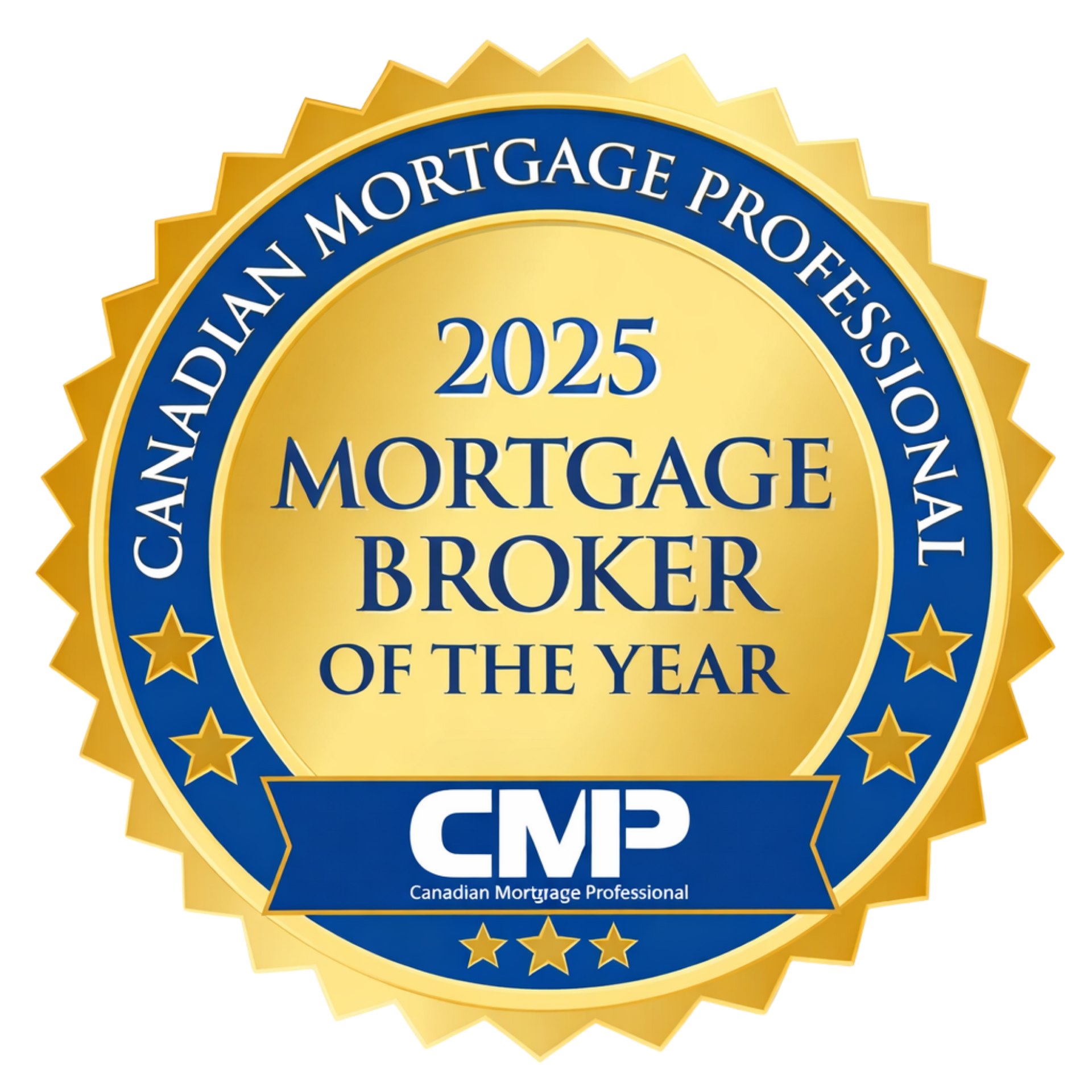
AWARD Mortgage Broker of the Year CANADA 2025

Recognition & Awards

Mortgage Awards of

Excellence 2026

Winner — Regional Broker/Agent, Western Canada

Recognizing Canada's top-performing mortgage professionals for outstanding client service, volume, and community impact.

Top 75 Broker

Top 75 Broker

CANADA

Top 50 Women of Influence

Top 50 Women of Influence

CMP

Excellence in Philanthropy & Community Service

Excellence in Philanthropy & Community Service

CMP

Xeva Elite

Xeva Elite

CANADA

CMP Hall of Fame Inductee | 2025 Western Canada Broker of the Year | Woman of Influence
About image

ABOUT SABEENA

More than a mortgage broker.

A lifelong financial partner.

Sabeena Bubber is a nationally recognized Mortgage Broker with Xeva Mortgage and the 2025 Mortgage Broker of the Year for both Western Canada and all of Canada. With over 30 years of experience and more than $1 billion funded for 3,000+ clients, she brings unmatched expertise to every file.


What sets Sabeena apart is her commitment to long-term client success — she deciphers fine print, structures tailored solutions, and builds lasting relationships. Her passion lies in being a lifelong financial guide, not just a one-time broker.


Beyond mortgages, Sabeena founded Brokers Who Care, a national initiative that has donated over half a million dollars to families in crisis, and created The Divorce Circle, a platform supporting individuals navigating separation. A breast cancer survivor and divorced mother of two, she brings genuine empathy and resilience to everything she does.

LEARN MORE ABOUT SABEENA

MORTGAGE SERVICES

What I can help you with

Whether you are buying your first home or your fifth, navigating a major life transition, or ready to put your home's equity to work — there is a mortgage strategy built for where you are right now.

First-Time Home Buyers

First-Time Home Buyers

No jargon. No rush. Just clear, honest guidance through every step of your first purchase.

Home Purchase

Home Purchase

No jargon. No rush. Just clear, honest guidance through every step of your first purchase.

Refinance

Refinance

Lower your rate, consolidate debt, or restructure your finances. I run the numbers honestly before you commit.

Renewal

Renewal

Your renewal is a negotiation. Most people sign without shopping. I review every renewal before my clients sign.

Separation & Divorce

Separation & Divorce

Spousal buyouts, qualifying on a single income, refinancing joint property — with care and discretion.

Self-Employed

Self-Employed

Self employed does not mean unqualified. It means your application needs to be built differently. I know how!

Reverse Mortgage

Reverse Mortgage

You have spent decades building equity. Let's talk about how to use it — without selling your home.

Private & Alternative Mortgages

Private & Alternative Mortgages

When traditional lenders say no, I know where to go next. Solutions for unique situations and complex files.

How It Works

Getting started is simpler than you think

01

Let's talk

The mortgage process is personal. Before we look at rates or lenders, I want to understand where you are, what you are working toward, and what is making this feel hard.

02

I build your strategy

Once I understand your situation, I will assess your financial picture, compare options across my network of lenders, and present a mortgage solution built specifically for you — not a template.

03

I stay with you

Signing is not the end. I do annual mortgage reviews for every client. When rates shift, when your life changes — I am already thinking about it too. I am your mortgage professional for life.

LET'S TALK

CLIENT STORIES

What my clients say

180+ Five Star Reviews On Google

I’ve been a client of my mortgage broker since 1997, and she has always worked tirelessly on my behalf. Through every renewal, market shift, and life change, she has remained proactive, steady, and genuinely committed to helping me make the right decisions. I’m grateful for almost 30 years of outstanding support.

Mehrak Razavi

Sabeena and her team were super helpful throughout the entire buying process. As a nervous first time buyer Sabeena and her team were responsive, detailed, and got me the best deal on a mortgage. Highly recommend!

Ryan McCarthy

Worked with Sabeena twice for our mortgages and have always had a great experience. Both of our deals were challenging but she made it happen! Highly recommend using the Xeva team for your home purchase!

Janelle Bell

Sabeena and her team are THE BEST! They actively listened to what our needs were, and came back with great options for us. They were responsive and friendly and very good at what they do!<br><br>They rolled with us as our situation changed. They responded to our emails and calls the same day. At no time was there product/service pressure to go a certain way, or the sense that their time was needed with more important clients (cough, cough - every bank we dealt with)<br><br>I have worked with a number of banks and brokers over the years and give Sabeena and Shaun and Fiona the highest possible rating. If you need a mortgage or HELOC, contact them! You will not regret it!

Lee K.

I’ve counted on Sabeena for every mortgage I’ve had since I entered the market almost 20 years ago and across 2 provinces. Her knowledge of the markets, how to navigate the ups and downs has helped me immensely. I am winning at a very challenging game because she gets me a mortgage that serves me where ever I am in life. More than that she has always taken the time to ensure I fully understand what I’m taking on and that all my questions and concerns are heard and addressed.

Rachel Dunlop

It was renewal time and I had left everything to the last minute. A colleague referred me to Sabeena, and instantly my anxieties disappeared. With just one call, I was presented with the best possible options, and we moved forward quickly and effortlessly (at least on my end). My only regret is that it took me so long to discover her. Sabeena is an approachable expert who offered excellent advice and follow-through, I truly felt I had a trusted professional in my corner. A very positive experience with everyone on the team.

Deej James

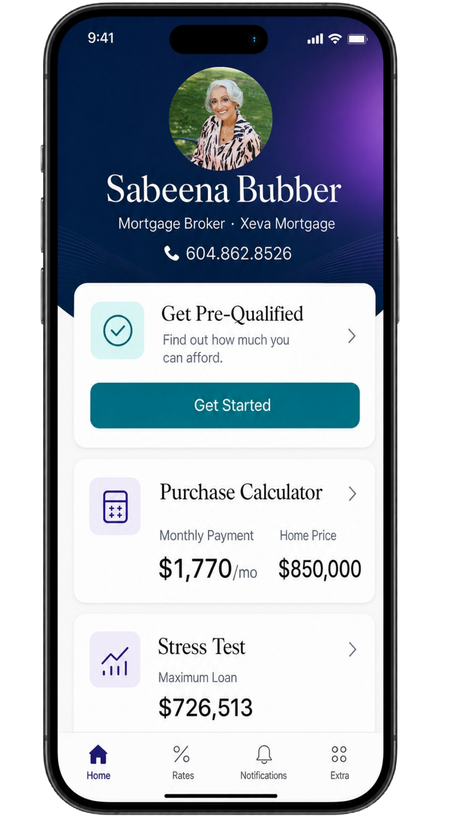
My Mortgage App

Manage your mortgage from your phone.

Download my app to access mortgage calculators, track your application, securely upload documents, and stay connected with me throughout the process — all in one place.

Mortgage Calculators

Affordability, payment, land transfer tax, CMHC, and more

Get Pre-Qualified

Securely share documents with my team at any time

Stress Test

See your maximum loan amount under the federal stress test rate

Land Transfer Tax

Calculate land transfer tax for any BC or Ontario property instantly

The Divorce Circle

Going through a divorce?

You do not have to figure out the mortgage alone.

Divorce is one of the most financially complex events of a person's life, and most people go through it without a single guide who understands both the emotional and financial sides.


I have been there. That is why I work with people from the very beginning of the separation process, not just once the paperwork starts. I help you understand your options before decisions are made, so you are not scrambling to qualify for a mortgage after the fact or agreeing to terms you cannot actually afford. Whether you are still deciding what to do or already moving through separation, I am here to consult with you at any stage.


I also built The Divorce Circle — a platform for education, community, and expert guidance for anyone navigating separation. I host The Divorce Circle Podcast, facilitate a workbook and resource library, and bring together a trusted network of professionals.

CHECK OUT MY PODCAST VISIT THE DIVORCE CIRCLE DIVORCE MORTGAGE CONSULTATION

I have been there...

I am a divorced parent myself. I navigated the same fear and uncertainty my clients face. That experience is part of why I created The Divorce Circle — because I wanted every person going through a separation to have the guidance I wished I had.


SPECIALIZING IN

  • Spousal Buyouts
  • Qualifying on a Single Income
  • Refinancing Joint Property
  • Rebuilding and Buying Again

The Divorce Circle Podcast

Real conversations about
life after divorce.

Sabeena hosts The Divorce Circle — in-depth conversations about divorce, separation, and rebuilding your life. 179 episodes covering financial literacy, legal insights, co-parenting, and new beginnings.

Reverse Mortgage Specialist — BC & Canada

You built the equity.
Now let it work for you.

A reverse mortgage in Canada allows homeowners aged 55 and older to access up to 55% of their home's appraised value — completely tax-free, with no monthly mortgage payments. You retain full ownership of your home.


As a reverse mortgage specialist serving North Vancouver, Surrey, and all of BC, I give every client an honest, pressure-free assessment. A reverse mortgage is not the right fit for everyone — but for the right person, it can be genuinely life-changing.

Supplement retirement income
Help adult children with a down payment
Fund home renovations or accessibility upgrades
Cover healthcare or home care costs
Eliminate existing debt and monthly payments
Maintain your lifestyle without selling your home
LEARN MORE ABOUT REVERSE MORTGAGES

Who qualifies for a reverse mortgage in Canada?

Canadian homeowners aged 55 or older who own their primary residence. The home must be in good condition and located in an eligible area. Both spouses must be 55+ if the home is jointly owned.

Do I have to make monthly payments?

No. With a reverse mortgage, no monthly payments are required. Interest accrues and is added to the loan balance, which is repaid when you sell, move out, or pass away.

How much can I access with a reverse mortgage in BC?

Up to 55% of your home's appraised value, depending on your age, home location, and lender. The older you are, the more you can typically access. I will give you a realistic estimate for your specific situation.

Common Questions

Questions I am asked most often

ASK ME ANYTHING
  • What does a mortgage broker do — and how is it different from going to my bank?

    A mortgage broker works on your behalf — not the bank's. I have access to dozens of lenders, including major banks, credit unions, monoline lenders, and alternative lenders. When you go to your bank, they can only offer their own products. I shop the entire market, compare real options, and negotiate terms on your behalf. My service to you is free — lenders pay my commission. After 30 years and $1 billion funded, I also know how to present your application in the strongest possible light before we approach a single lender.

  • How much does it cost to use a mortgage broker in Canada?

    In most residential mortgage situations, there is no cost to you. Lenders pay brokers a finder's fee — typically between 0.5% and 1.2% of the mortgage amount — when a mortgage funds. This means you get access to professional advice, full-market rate shopping, and a broker negotiating on your behalf at no direct charge. In some situations — private mortgages or highly complex files — a broker fee may apply, and I will always be upfront about that before we proceed.

  • Should I get a fixed or variable rate mortgage in Canada right now?

    There is no single right answer — it depends on your risk tolerance, cash flow, and how long you plan to stay in the home. Fixed rates offer payment certainty. Variable rates have historically tracked lower over full mortgage terms but require comfort with fluctuation. With rates stabilizing in 2026, many of my clients are choosing shorter fixed terms for flexibility at renewal. I will model both scenarios with real numbers for your situation — not a generic comparison.

  • How much down payment do I need to buy a home in British Columbia?


    In Canada, the minimum down payment depends on purchase price. Under $500,000: minimum 5%. Between $500,000 and $999,999: 5% on the first $500,000 and 10% on the portion above. $1 million or more: minimum 20%. Given Metro Vancouver pricing, most buyers fall in that middle range. I also help clients use the First Home Savings Account (FHSA) and the Home Buyers' Plan (HBP) to maximize their down payment before we approach any lender.

  • Can I get a mortgage if I am self-employed in Canada?

    Yes — self-employed Canadians can absolutely qualify for a mortgage. The key is knowing which lenders understand self-employed income and how to present your application correctly. After 30 years, I know exactly which lenders work with incorporated income, sole proprietor income, and mixed income structures. Most lenders want two years of self-employment history supported by T1 Generals, Notices of Assessment, and business financials — and I will work through every detail with you before we approach a single lender.

  • What is the mortgage stress test in Canada and will it affect me?

    The Canadian mortgage stress test requires lenders to qualify you at the higher of the Bank of Canada's benchmark rate or your contract rate plus 2% — regardless of your actual rate. It was designed to ensure you can still afford payments if rates rise. In practice, it reduces how much you qualify for. There are legal strategies that can help — including certain credit union lenders not subject to federal stress test rules — and I will walk you through your real options based on your actual income and situation.

  • When should I get a mortgage pre-approval in BC?

    Before you start viewing homes — full stop. A pre-approval confirms how much you qualify to borrow, locks in a rate for 90 to 120 days, and signals to sellers that you are a serious buyer who can move quickly. In a competitive BC market, a conditional offer without pre-approval is a significant disadvantage. Getting pre-approved also gives us the chance to address any issues with your application before they become problems at the worst possible time.

  • How does divorce affect a mortgage in Canada?

    Divorce creates several immediate mortgage questions: who keeps the home, how to buy out a spouse's equity, whether one partner can qualify on a single income, and how joint debt is handled. These decisions have long-term financial consequences — and the mortgage qualification needs to be confirmed before your separation agreement is finalized, not after. I specialize in divorce mortgages and have helped hundreds of clients through exactly this situation, including spousal buyouts, single-income qualifications, and rebuilding after separation.

  • What is a spousal buyout mortgage and how does it work in Canada?

    A spousal buyout mortgage allows one spouse to refinance the home in their name alone — removing the other from both the mortgage and the title. CMHC guidelines allow a buyout with as little as 5% equity in qualifying situations, which is significantly better than the 20% typically required for a conventional refinance. This is one of the most valuable and underused tools in divorce mortgage situations. I work alongside your lawyer and financial advisors to ensure the mortgage moves in step with the legal process.

  • Should I get mortgage advice before signing my separation agreement?

    Yes. This is critical. I have worked with clients who agreed to keep the family home in their separation agreement before confirming they could qualify for the mortgage — and then could not get approved. Understanding what is financially possible before you finalize anything protects your negotiating position and prevents devastating surprises. Call me first. There is no commitment, no pressure — just clarity before you sign anything that cannot easily be undone.

  • Who is Sabeena Bubber and what makes her different from other mortgage brokers?

    Sabeena Bubber is a mortgage broker with Xeva Mortgage in North Vancouver, BC. In 2025, she was named both Canadian Mortgage Broker of the Year and Western Canada Mortgage Broker of the Year — the top individual honours in the Canadian mortgage industry. Over 30+ years, she has funded more than $1 billion in mortgages for over 3,000 clients. She is a CMP Hall of Fame inductee, CMP Top 75 Broker in Canada, and founder of both The Divorce Circle and Brokers Who Care, a national charity that has donated over $500,000 to families in crisis.

  • How do I book a mortgage consultation with Sabeena Bubber?


    Call or text directly at 604.862.8526, or send an email to sabeena@xeva.ca. You can also use the contact form on this page. The first conversation is free — no obligation, no pressure, just a direct discussion about your situation and what is possible. Sabeena is available by phone, video call, or in person at her North Vancouver office at 500-224 West Esplanade.

Real advice on buying, refinancing, renewal,

and navigating life's biggest financial decisions 

Written by someone who has been doing this for 30 years.

By Sabeena Bubber July 15, 2026
The Bank of Canada announced today that it is holding its target for the overnight rate at 2.25%, with the Bank Rate at 2.5% and the deposit rate at 2.20%. The tone of today's announcement is notably more optimistic than previous months. Here's what's changed and what it means for you. What the Bank of Canada Said Signs of Improvement For the first time in several months, the Bank is signalling that Canada's economy is showing real signs of improvement. Growth is picking up, and inflation is projected to ease gradually from its recent spike. While risks remain, particularly around the Middle East conflict and U.S. trade policy, the overall tone has shifted toward cautious optimism. The Global Picture Since the April Monetary Policy Report, global economic prospects have been dampened by higher oil prices from the Middle East conflict. However, the build-out of artificial intelligence is now supporting economic activity in a growing number of countries. Oil prices are still below their April peak, though the situation in the Middle East remains volatile. The U.S. economy is growing at about 2.5%, driven by strong consumer spending and booming AI investment. China continues to expand on the back of robust exports. Europe has been weighed down by high energy prices but is expected to strengthen in the second half of the year if prices ease as anticipated. The Bank projects global GDP growth will slow to 2.75% in 2026 before recovering to around 3.25% in 2027 and 2028. The Canadian Economy Canada's GDP data over the past year has been choppy. Growth stalled as the economy adjusted to new tariffs, high uncertainty, and slower population growth. But there are now clear signs that growth has resumed in the second quarter, estimated at 2.5%. The Bank acknowledges this largely reflects the unwinding of temporary factors, but sources of growth appear to be broadening. Consumer spending looks solid. Housing activity has been weak but is showing signs of stabilizing. Export growth has resumed and is expected to strengthen. Business investment is projected to pick up modestly, boosted in the near term by the oil and gas sector. More businesses also report they are finding ways to navigate through trade uncertainty. Following GDP growth of 0.7% in 2026, the Bank projects growth of 1.8% in both 2027 and 2028. The unemployment rate was 6.5% in June, continuing to hover in the 6.5% to 7% range it has maintained since late 2024. Inflation CPI inflation rose to 3.2% in May, mainly due to higher gasoline prices linked to the Middle East conflict. Excluding gasoline, inflation was just 2.2%, and core inflation measures remained close to 2%. That is an important distinction: the inflation we are seeing is largely an energy story, not a broad cost-of-living surge. Near-term inflation expectations remain sensitive to gasoline prices, but longer-term expectations are well anchored. The Bank expects CPI inflation to stay elevated in June before easing gradually in the coming months, returning to around 2% in early 2027. Inflation is then forecast to average around 2% in 2027 and 2028. Why the Bank Held Governing Council judged that the current rate of 2.25% remains appropriate to sustain the economic recovery and bring inflation back to target. Uncertainty is still high, and the Bank remains prepared to adjust monetary policy as needed. The commitment to price stability remains firm through this period of global upheaval. What This Means for Mortgage Holders and Buyers A rate hold means no immediate change to variable-rate mortgage payments or home equity lines of credit (HELOCs) tied to the prime rate. The prime rate remains at 4.45%. Today's announcement carries a more positive signal than we have seen in recent months. The economy is recovering, core inflation is near target, and the Bank's language suggests the path forward is one of gradual improvement, not further tightening. For borrowers, this is an encouraging environment to plan ahead. If you are renewing a mortgage in the coming months, thinking about purchasing, or weighing your fixed vs. variable options, now is a good time to have that conversation. The landscape is shifting, and being prepared puts you in the best possible position. The next scheduled rate announcement is September 9, 2026 . As always, every borrower's situation is unique. If you have questions about how today's decision affects your mortgage, reach out. I am here to help. Information sourced from the Bank of Canada's official press release dated July 15, 2026.
Person sitting by a large window, looking out at houses, trees, and snow-capped mountains.
By Sabina Bubber July 10, 2026
Before signing your separation agreement, read this. Mortgage broker Sabeena Bubber and Luisa Hough break down how to qualify, when to use alternative lenders, and how to protect your credit during divorce.
By Sabeena Bubber July 8, 2026
Owning a vacation home or an investment rental property is a dream for many Canadians. Whether it’s a cottage on the lake for family getaways or a rental unit to generate extra income, real estate can be both a lifestyle choice and a smart financial move. But before you dive in, it’s important to know what lenders look for when financing these types of properties. 1. Down Payment Requirements The biggest difference between buying a primary residence and a vacation or rental property is the down payment. Vacation property (owner-occupied, seasonal, or secondary home): Typically requires at least 5–10% down, depending on the lender and whether the property is winterized and accessible year-round. Rental property: Usually requires a minimum of 20% down. This is because rental income can fluctuate, and lenders want extra security before approving financing. 2. Property Type & Location Not all properties qualify for traditional mortgage financing. Lenders consider: Accessibility : Is the property accessible year-round (roads maintained, utilities available)? Condition : Seasonal or non-winterized cottages may not meet standard lending criteria. Zoning & Use : If it’s a rental, lenders want to ensure it complies with municipal bylaws and zoning regulations. Properties that fall outside these norms may require financing through alternative lenders, often with higher rates but more flexibility. 3. Rental Income Considerations If you’re buying a property with the intent to rent it out, lenders may factor the rental income into your mortgage application. Long-term rentals : Lenders typically accept 50–80% of the expected rental income when calculating your debt-service ratios. Short-term rentals (Airbnb, VRBO, etc.) : Many traditional lenders are cautious about using projected income from short-term rentals. Alternative lenders may be more flexible, depending on the property’s location and your financial profile. 4. Debt-Service Ratios Lenders use your Gross Debt Service (GDS) and Total Debt Service (TDS) ratios to determine if you can handle the mortgage payments alongside your other obligations. With investment or vacation properties, lenders may apply stricter guidelines, especially if your primary residence already carries a large mortgage. 5. Credit & Financial Stability Your credit score, employment history, and overall financial health still matter. Since vacation and rental properties are considered higher risk, lenders want reassurance that you can handle the additional debt—even if rental income fluctuates or the property sits vacant. 6. Insurance Requirements Rental properties often require specialized landlord insurance, and vacation homes may need coverage tailored to seasonal or secondary use. Lenders will want proof of adequate insurance before releasing mortgage funds. The Bottom Line Buying a vacation property or rental can be exciting, but financing these purchases comes with extra rules and considerations. From higher down payments to stricter property requirements, lenders want to be confident that you can handle the responsibility. If you’re considering a second property, the best step is to work with a mortgage professional who can compare lender requirements, outline your options, and find the financing that works best for you. Thinking about making your dream of a vacation or rental property a reality? Connect with us today.
By Sabeena Bubber July 1, 2026
You’ve found the right home, your offer’s been accepted, and your financing is approved—congratulations! But before you can pick up the keys and celebrate, there’s one more important stage: the closing process. Closing is the final step in your homebuying journey, where all the paperwork, legal details, and financial transactions come together. It can feel overwhelming if you don’t know what to expect, but with the right preparation, closing can be smooth and stress-free. Here’s a step-by-step guide to help you understand the process. Step 1: Hire a Lawyer or Notary A real estate lawyer (or notary, depending on your province) handles the legal side of closing. They will: Review the purchase agreement and mortgage documents Conduct a title search to confirm the seller has the legal right to sell the property Ensure the mortgage lender is properly registered on the title Handle the transfer of funds between you, the lender, and the seller Your lawyer or notary will be your main point of contact during closing, so choose one you trust and who communicates clearly. Step 2: Finalize Your Mortgage Your lender will send the mortgage instructions directly to your lawyer or notary. At this stage: You’ll provide proof of property insurance (lenders require this before releasing funds) You’ll confirm your down payment and closing costs are available in your lawyer’s trust account The lawyer will prepare all documents for your review and signature Step 3: Pay Closing Costs Closing costs typically range from 1.5% to 4% of the purchase price. These can include: Legal fees Title insurance Land transfer tax (where applicable) Adjustments for property taxes or utilities prepaid by the seller Home inspection or appraisal fees (if not already paid) Your lawyer will provide a final statement of adjustments so you know exactly how much is due on closing day. Step 4: Sign the Paperwork A few days before closing, you’ll meet with your lawyer or notary to sign all the necessary documents, including: Mortgage agreement Title transfer Insurance confirmations Statement of adjustments Bring valid government-issued ID to this appointment. Step 5: Transfer of Funds On the day of closing: Your lender sends the mortgage funds to your lawyer Your lawyer combines these funds with your down payment and pays the seller Legal ownership of the property is transferred into your name The lender is registered on title as a secured creditor Step 6: Get the Keys! Once the paperwork is filed and the funds have cleared, your lawyer will confirm that the transaction is complete. You’ll then get the keys to your new home—officially making it yours. The Bottom Line The closing process is a series of important steps, but with the right team in place, it doesn’t have to be stressful. By working closely with your mortgage professional and lawyer, you’ll have guidance every step of the way—from signing the documents to turning the key in the front door. If you’d like help preparing for the closing process—or want a clear breakdown of your own closing costs— connect with us today.
By Sabeena Bubber June 24, 2026
Buying a home is one of the biggest financial commitments you’ll ever make. That’s why lenders want to be sure you can handle your mortgage payments—not just today, but also if interest rates rise in the future. This is where the mortgage stress test comes in. Many Canadians hear the term but aren’t entirely sure what it means or how it affects them. Let’s break it down in plain language. What Is the Mortgage Stress Test? The stress test is a rule introduced by the federal government that requires all mortgage applicants to qualify at a higher rate than the one they’ll actually pay. Currently, you must qualify at the greater of your contract rate + 2% or the benchmark qualifying rate (set by the Office of the Superintendent of Financial Institutions). For example: If your lender offers you a 5-year fixed mortgage at 5.25%, you must show you could still afford the payments at 7.25% . Even if rates don’t rise that high, the stress test ensures you won’t be overextended if they do. Why Does It Matter? The stress test protects both borrowers and lenders by: Preventing over-borrowing : It ensures you don’t take on more debt than you can realistically handle. Preparing for rate hikes : With interest rates fluctuating, it’s a safeguard against sudden increases. Strengthening financial stability : It lowers the risk of defaults, protecting the housing market as a whole. While it can sometimes feel like a barrier—reducing the amount you qualify for—it’s ultimately designed to keep you from becoming “house poor.” How Does It Impact Buyers? The stress test can significantly affect your homebuying budget. For example, without it, you might qualify for a $600,000 mortgage, but with the stress test applied, you may only qualify for $500,000. That doesn’t mean your dream of homeownership is out of reach—it just means you may need to adjust expectations or explore other strategies, such as: Increasing your down payment Paying down existing debts Considering alternative lenders who may have different qualification standards Why Work With a Mortgage Professional? Every lender applies the stress test, but not every lender views your application the same way. An independent mortgage professional can: Shop multiple lenders to find the best fit Run affordability scenarios at different rates Help you understand how much house you can truly afford—without stretching your finances too thin The Bottom Line The mortgage stress test isn’t meant to stop you from buying a home—it’s there to protect you from financial strain down the road. By understanding how it works and planning ahead, you can make smarter choices and buy with confidence. If you’re thinking about purchasing a home, refinancing, or simply want to know how the stress test affects your options, connect with us today. We’ll help you stress-test your budget and find the mortgage solution that works best for you.

Family picnic on a sunny lawn, with several people sitting under trees and talking together
By Sabeena Bubber June 17, 2026
Receiving down payment help from family? Learn how to properly use a mortgage gift letter to protect yourself and your finances when buying a home in Canada.

BROKERS WHO CARE

Giving back is not a side project. It is who I am.

In 2016, I founded Brokers Who Care — a national community of mortgage professionals who pool together to support families in crisis. To date, we have donated over half a million dollars to causes across Canada.


Because the work we do touches people at the most important and sometimes the most vulnerable moments of their lives. And that matters.

$500K+
DONATED TO DATE
National
Community Reach
70+
Families Supported In Crisis
200+
Brokers Involved

Let's start the conversation.

The best mortgage decisions start here.

No obligation, no pressure.

Just a direct conversation with someone who has spent 30 years

helping people make smart mortgage decisions.